Escorted Tours

Failte gu Fuadach nan Gaidhealt na h-Alba

Failte gu Fuadach nan Gaidhealt na h-Alba.
The Highland Clearances were a devestating part of the history of Scotland. For many it changed not only their way of life but also shaped the rural future of Scotland. Many villagers suffered at the hands of their landlords and tackmen and fought a desperate struggle to find a new life. Others managed to propser in a new life that never saw them return to Scotland again. Here is a resource that supports the documentation and historical value of this important area of Scottish history. You can follow in the footsteps of these villagers and find detailed descriptions and locations of the remains of some of the villages and townships through site descriptions, photographs and suggestions for further reading and links to follow.


Showing posts with label Glen Tarken. Show all posts

Monday, 27 February 2012

Glen Tarken and her townships 3. Morell Township.

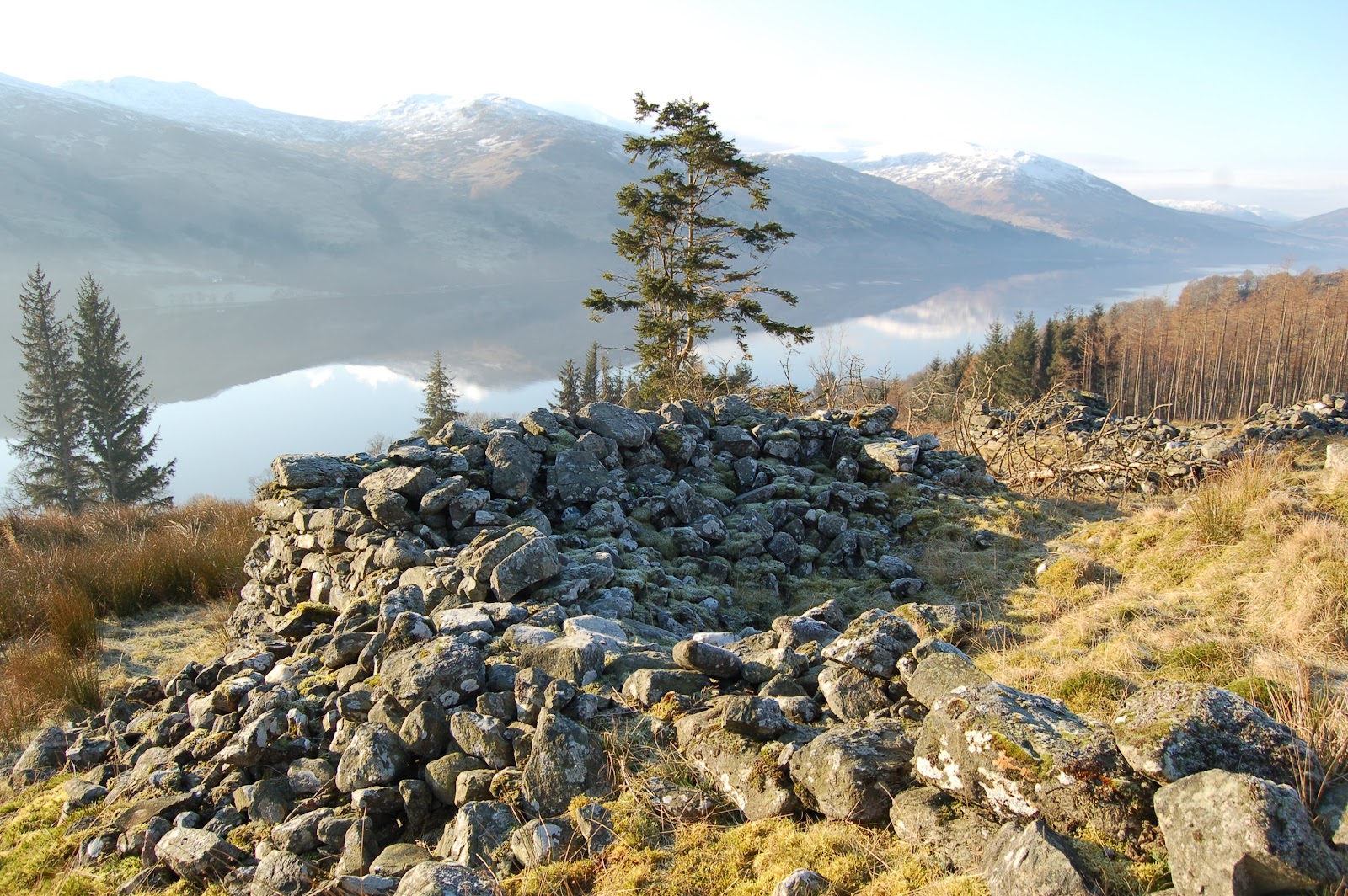
This township is the last that we visit on this trip to this particular Glen at this time and one could consider this to be the main attraction of the day.

Morell Township. C: Author
Walking down to the site from Jerusalem, the site looms into view.  As you approach the site you will walk through a walled fence area that also has the remains on both sides of the wall, both higher and lower to your position on the path. Again, take time to view these sites. As you get closer to the main site, there is a large deer fence that seperates the village from your current position, but a gated styal affords you access to the site.  The deer fence is there for a reason as there are plenty of forestry work and logging taking place at present.

Whilst I was there, I was rewarded with a visit from several deer who made their way through the village. I am never sure as to whether the fence is there to keep them in or out! Upon entering the site, I implore you to stop and take in the views all around you which, on the day that I visited, were breathtaking.


Morell Township: C: Author

Morell Township. C: Author

This is a large township that can be traced easily over the area. The buildings, their divisions and layout can easily be identified and distinguished. There are outlines of a large walled sheepfold at the rear right of the site and the remains of a well area to the northeast of the site. Alot of the buidling are almost gone now but it is worth taking time to absorb the site and consider the conditions such an elevated and sloped site must have had on the community living here. The hardships faced to just survive each day.

At the end of your time at the site, you have two options for return. Retracing your steps back along the path to Wester Glen Tarken and the A85 is probably the best. You can walk straight down the hill in front of you, it is steep,but there is a path/track that you will pick up. Here you can also rejoin the disused railway route and turning left picking up the logging road back to the A85. Although this is the shortest route, I would not advise it as the logging work being carried out can be a dangerous area to enter.

Wednesday, 15 February 2012

Glen Tarken and her townships 2. Jerusalem.

Jerusalem Cottage. Copyright Author
Returning to our posts on the Glentarken area. We leave behind the township of Wester Glentarken and following the path up and around the back of the village. We climb up and follow the path round until we come to a bridge on our right that stretches across the burn. It is worth stopping here for a moment to enjoy the falls below and also note the remains of further buildings, behind us to the left, that make up the wider Glentarken community.


Copyright: Crown

Carrying on, across the bridge follow the path up until you arrive at the remains of a building situated next to the renovated croft house. Here you have arrived at Jerusalem.

There is some confusion as to the naming and placing of the townships of Glentarken, Morell and Jerusalem. This area is annotated as 'Easter Glentarken' as depicted on the 1st edition of the OS 6-inch map (Perthshire 1867, sheet xciii). We can identify the area on the map as comprising of three roofed, two partially roofed buildings and two enclosures. Later OS maps show this area as Jerusalem and the Easter Glentarken as slightly higher up the Glen. (As shown here). A later posting will add more information about
Easter Glentarken.

Jerusalem cottage. Copyright: Author
Very little is known as to why this particular township area is known as Jerusalem but there is a lot of information relating to two saint fillans, and the close relationship to the area of St. Fillan at Loch Earn. One of Irish and one of Scottish Origin .The St. Fillan whose feast is kept on 20 June had churches dedicated to his honour at Ballyheyland, County Laois, Ireland and here at Loch Earn, Perthshire. References to the feast of St. Fillan being on 19 January occasionally appear and agreement upon which is correct has not been reached.


Remains close to Jerusalem. C: Author
There is evidence to show that the Saint, and his followers, held a house in the area. Further information regaring this heritage can be read here from an article written in 1895. (Courtesy Archaeological Data Service, University of York).

What ever the story, and what ever the reason, I find this a really interesting area and one of such beauty. Throughout my visit , I was occasionally joined by deer running across the area, and of course amazing views. Don't rush your visit to this area, but immerse yourself in the history and emotion of the villages.

Monday, 6 February 2012

Glen Tarken and her townships 1 . Wester Glentarken, Loch Earn.

Loch Earn from Easter Glentarken. C: Author
As I sit here writing this post watching the snow fall heavily onto the paths and garden outside, it is hard to think that this photo, and my visit to this area was only last Friday, when I was blessed with a crisp white morning that gave way to brilliant sunshine and a degree of early year warmth that made the visit to the townships of Glen Tarken a joy.

This is my first visit to the area to record the townships and  and as I now study the OS maps and research further the information on the area, I think you will find this area as interesting as I.


The shores of Loch Earn, and this particular region, provides an area comprising of more than one settlement in close proximity to each other. There are the remains of the settlements that are known as Easter and Wester Glentarken, the township of Morell and an interesting site known as Jerusalem, which I hope to add verse to in a later posting.

Wester Glentarken. Copyright: NLS/Crown
We approach Wester Glentarken from the roadside on the A85. We move swiftly through a farm path and very quickly the township comes into view, being a mere 10 minutes walk from our starting point. 

The village or clachan, as the orginal collection of dewllings were known as, contains the remains of thirteen rectangular buildings, four kilns (one probably a lime-kiln) and associated enclosures. The buildings vary in size from 31.0m x 5.5m to 7.0m x 4.5m with walls up to 2.0m in height.


There is a barn in the middle of the clachan that has been roofed and used for many different uses to support rural life in the community.  Enquiries carried out by previous  reserchers have revealed that the larger group of buildings included a school for  upto sixty children and that the area was finally depopulated about the turn of the last century.

There are further remains to the left of the pathway slightly further along the path that would have formed the same township area.

Wester Glentarken. C: Author

Wester Glentarken. C: Author

Wester Glentarken. C: Author

Wester Glentarken. C: Author


The next posting in this series will take us up past Wester and towards the village of Easter Glentarken.